From Club to Brand: Branding as a Driver of the Future of Sport
- Mar 13
- 3 min read
Some clubs play matches every weekend. Others are playing a far more complex game: staying relevant in a world where sport no longer lives only inside the stadium.
Today, a club’s future is not decided solely by results or league standings at the end of a season. It increasingly depends on its ability to build a strong brand and a meaningful narrative rooted in purpose. All this in a context where entertainment options are endless and loyalty can no longer be taken for granted.
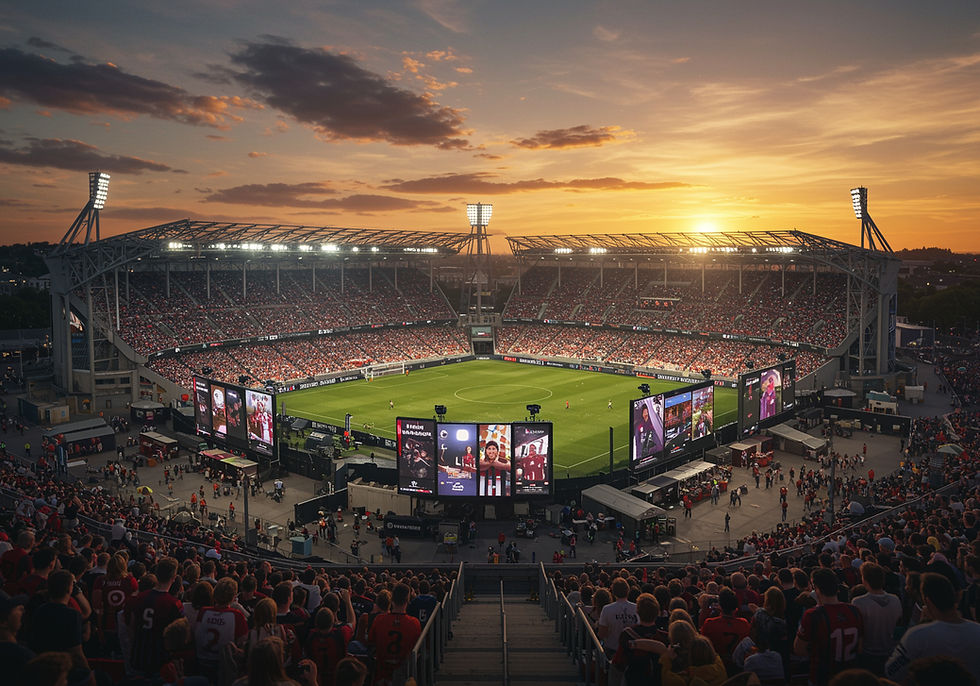
Sports clubs in the age of cultural brands
“The most successful sports organisations think like media companies and act like brands.” — Harvard Business Review, opinion article on sports branding.
This idea is no longer theoretical. Clubs, and competitions themselves, are not just competing against other teams for titles. They are also competing with content platforms, lifestyle brands and new cultural references that often know how to tell their stories better.
Thinking like a media company means producing constant, relevant and coherent content. Acting like a brand means having a clear identity, recognisable values and a promise that holds true beyond the result on the pitch.
Over the past few years, one reality has become increasingly clear. The teams that create the most value are not only those that win trophies, but those capable of expanding their cultural and commercial influence far beyond the field of play.
According to Forbes’ list of the 50 most valuable sports teams in the world in 2025, the Dallas Cowboys lead the ranking with a valuation of 13 billion dollars. They are followed by NFL and NBA franchises such as the Golden State Warriors and the Los Angeles Lakers. All of them sit well above most European football clubs, even though football remains the most globally relevant sport, and far ahead of the rest of the European sports landscape.
This is not accidental. In the United States, sports organisations have spent decades treating the brand as the central asset of their business. They manage media rights, sponsorships, fan communities, merchandising and editorial content in ways that resemble media companies. The NFL alone places 30 of its 32 franchises among the 50 most valuable teams in the world.
Europe, and Spain in particular, tells a different story. Clubs like Real Madrid and FC Barcelona appear in the Top 50, but they are among the very few that have managed to build a global brand ecosystem capable of generating commercial value independently from their sporting performance.
The contrast is revealing. It highlights a challenge that many European clubs now face. The market no longer values competition alone. Narrative, community and the ability to generate constant cultural and media impact are becoming equally decisive. In this area, North American sports brands have been pioneers for years.
Branding is not design. It is direction.
Branding is still too often reduced to a visual exercise. But design is only the visible consequence of a deeper decision: having a clear direction.
As several Brand Finance reports point out, the most valuable sports brands are not those that change the most. They are the ones that understand who they are, what they represent and why they exist.
This is the difference between a brand that reacts and a brand that leads.
When approached strategically, branding works like a compass. It guides the decisions a club makes, from communication and sponsorships to partnerships and the way it relates to its community. This is where purpose becomes essential. Without purpose, a brand is decoration. With purpose, it becomes a system.
Purpose is not a slogan. It is a guiding idea that gives coherence to a narrative, organises growth and helps a club make difficult decisions without losing its identity.
When a club truly understands its purpose, design, tone of voice and actions stop being arbitrary. They become consistent expressions of the same idea.
Brand, business and sustainability
When a club works on branding strategically, the benefits go far beyond image. It improves the perception of professionalism. It makes it easier to attract sponsors with aligned values. It creates new commercial assets and opportunities.
Branding does not guarantee sporting victories. It does provide stability and long-term projection.
Takeaway
A club that does not build itself as a brand becomes overly dependent on results. A club with a strong brand builds its future.